


A case study in reconciling DIN 22252, DIN 22255 and GB/T 12718 — and in what a Charpy value really buys you underground
Every few months an inquiry arrives that looks routine on the first page and turns out to be a metallurgical argument. One recent example: a 38×137 mm compact chain for an armoured face conveyor, specified at a test force of 1,360 kN, a minimum breaking force of 2,040 kN, and a Charpy V-notch impact energy of 57 J on coupons cut from the non-weld area of the link. Each figure is defensible alone. Together they describe a chain that exists in no standard — and understanding why is the difference between a competitive quotation and an unprofitable one.
What the standards actually require
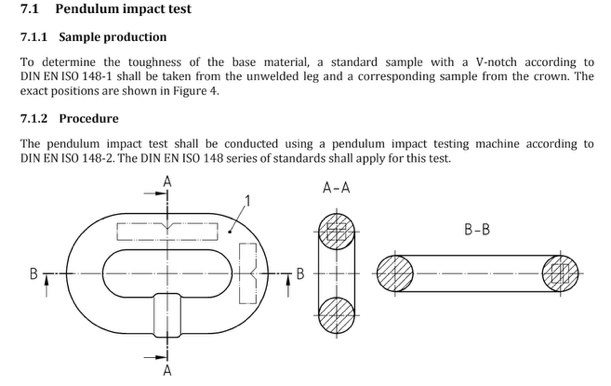
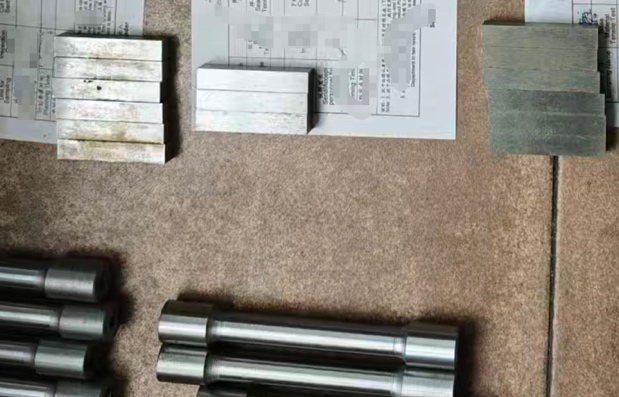
DIN 22252:2012, clause 5.6, is unambiguous. For chains of 26 mm and above with a tensile strength between 1,097 and 1,220 MPa, the base material in the leg and in the crown must reach at least 57 J at room temperature, as the average of three samples per material batch, with no individual value below 70 per cent of that average — a floor of 40 J. Specimens are V-notched and cut from the unwelded leg and from the crown.
DIN 22255, the flat link and compact chain standard, repeats the 57 J and sets 38×137 mm at 1,360 kN test force and 1,820 kN breaking force. Clause 5.4 of both standards fixes hardness at 350 to 390 HV10 — the same 1,097 to 1,220 MPa in other units. So the customer's 57 J is not exotic; it is the German baseline, with two omissions: the inquiry asked only for the non-weld area, and named no test temperature.
The Chinese standard measures something else
GB/T 12718-2009 specifies grade C chain of the same size at 1,450 kN test force and 1,810 kN breaking force, and clause 5.6.5 requires only 15 J — measured at the weld, with a U-notched specimen, two per link. The weld is the weakest point in a chain; the base metal of the leg is the strongest. Comparing 15 J with 57 J is therefore not a comparison at all, which is why Chinese mills and European buyers so often talk past each other on this subject.
Both DIN standards treat impact as an additional test agreed at ordering, alongside fatigue; GB/T runs it only on request. Routine acceptance in all three rests on dimensions, tensile, bending and hardness.
Where the specification actually bites
A 38 mm link has a nominal section of 2,268 mm², so 2,040 kN corresponds to 899 N/mm² — roughly 12 per cent above the 1,820 kN in both DIN standards, and between GB/T grade C at 800 N/mm² and grade D at 1,000 N/mm².
That matters because 57 J is calibrated to a strength window. If DIN's 1,820 kN is reached at the middle of its hardness band, the link converts about 0.69 of the material's tensile strength into breaking load. Applying the same ratio, 2,040 kN implies a tensile strength near 1,300 MPa, or some 415 HV10 — about 25 points above the DIN ceiling. The customer is asking for 57 J outside the band in which 57 J was validated. It is achievable, but it is a deviation, and it should be documented and priced as one.
A second inconsistency is worth raising. The proof ratio is 1,360 over 2,040, or 0.67, against 0.75 in DIN and 0.80 in GB/T; commercial 2,040 kN grades pair a 1,480 to 1,500 kN test force. A 2,040 kN chain proven at 1,360 kN is screened at two-thirds of its break load instead of three-quarters — almost certainly a drafting oversight, and cheap to correct.
What a higher impact value buys
- Shock survival. Hard blockage, a stall restarted under load or tramp steel are the events where toughness, not fatigue strength, decides whether a link bends or shatters.
- Cold margin. Charpy is dynamic, so it captures the strain-rate shift in the ductile-to-brittle transition that a tensile test misses.
- Flaw tolerance. Corrosion pits and weld-toe defects behave very differently in a 57 J material than in a 27 J one.
- A fail-safe failure mode. A ductile link bends visibly before it breaks, giving the mine a warning and a planned stop.
- A proxy for clean steel — which is where the real fatigue benefit hides.
What it costs
Toughness is insurance against rare events; hardness is income earned every shift. Abrasive wear scales inversely with hardness, so 30 HV of extra softening costs roughly 10 per cent of wear life — and wear is what drives pitch growth, sprocket mismatch and the vibration that shortens fatigue life. Softening a chain to survive shocks can generate more shocks. Beyond about 55 to 60 J at room temperature, the money is better spent on weld quality, surface integrity and corrosion protection.
Getting 57 J from 23MnNiMoCr54 without giving away hardness
- Buy cleanliness, not softening. Sulphur at or below 0.008 per cent, phosphorus at or below 0.012 per cent, oxygen at or below 20 ppm, calcium-treated inclusions and a fine prior-austenite grain raise toughness and fatigue limit together, at no cost in hardness.
- Austenitise at 860 to 880 °C, never above 900 °C, with carbon potential controlled to prevent decarburisation — a known weakness of this steel, and exactly where a leg coupon is taken.
- Quench hard enough for full martensite through 38 mm. Any ferrite or coarse bainite band caps toughness regardless of tempering.
- Temper in the 520 to 600 °C band, preferably twice. This is the dial that trades hardness for joules, so it is the last one to turn.
- Control hydrogen: bake after acid pickling, and do not galvanise without stress relief.
- Sample properly: longitudinal, mid-radius, from the straight leg, tested at 20 ± 2 °C to ISO 148-1.
How to write the requirement so both sides can live with it
Specify 57 J average at 20 ± 2 °C on full-size 10×10 mm specimens, with no individual value below 40 J, taken from the leg and — if DIN is the reference — the crown. Treat Charpy as a type test with periodic verification rather than a lot-release criterion, and prove capability first: a process mean of at least 70 J is what lets a 57 J average survive normal scatter. Anything less and you are shipping test reports rather than chain.
If you are evaluating a mining chain specification and something in the combination does not reconcile, that is usually the most useful conversation we can have — before the purchase order, not after the first failed test.
Post time: Nov-25-2026
